
Walking from Roppongi to Tokyo Tower: A Route Ordered by How the Tower's Appearance Changes
Walking from Roppongi to Tokyo Tower: A Route Ordered by How the Tower's Appearance Changes
Tokyo Tower? I went up it on my last trip. Took the photos, too.
If that sounds like you, there's something I'd like you to try on your next visit to Tokyo. Instead of focusing on arriving at the tower, enjoy the part where you're getting closer to it.
On the walk from Roppongi to Tokyo Tower, your destination keeps slipping in and out of view. And the farther you walk, the more its appearance changes. This guide is for first-timers on this route, and it follows the order in which the tower's appearance changes.
Before You Leave Roppongi: Find Out Which Way Tokyo Tower Is
The first step is simple. In this article, the example route starts at Roppongi Crossing, follows Gaien-Higashi-dori toward Iikura, passes the Iikura-katamachi intersection, and ends near Shiba Park at the foot of the tower. Before you set off, open Google Maps on your phone, set "Tokyo Tower" as your destination, and pull up the walking route. That's all you need.
That said, it would be a shame to spend the whole walk staring at your screen. Think of the route as a backup in case you get lost, and the walk becomes much more fun. Tokyo Tower is one of the most visible landmarks in Tokyo. As long as you know roughly which way it is, you're unlikely to go far off course.
To be honest, this kind of walk works better if you don't worry about how many minutes it takes. That goes double if you remember a past trip where you packed in too much and getting from place to place was nothing more than travel time. This time, make the journey itself the goal. Stopping and taking detours are all part of the walk.
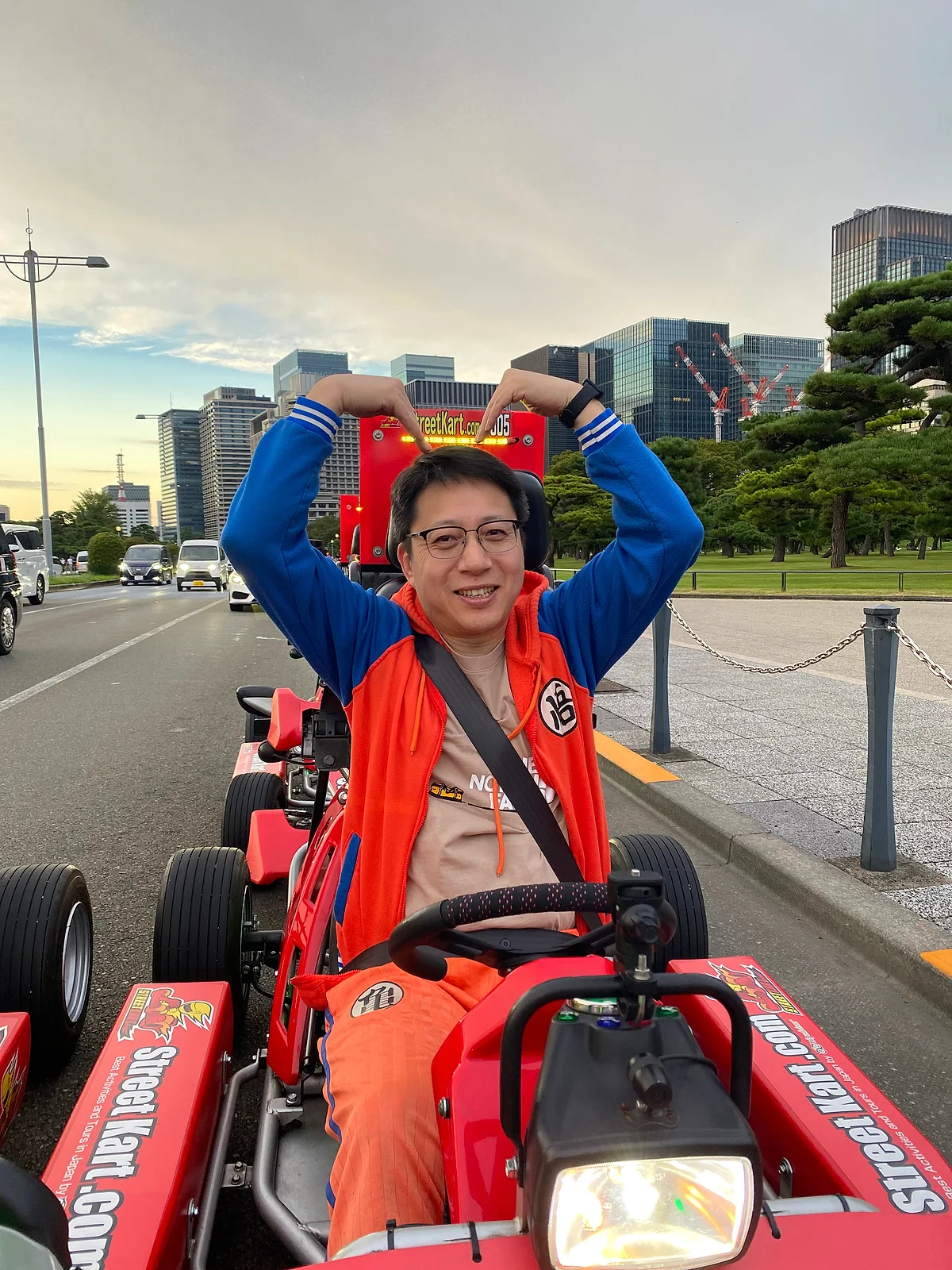
Before you leave, check your shoes and your phone battery too. On this walk you'll keep looking up, stopping, taking a photo, and walking on again. If you keep switching between the map app and the camera, your battery will drain faster than you expect, so bring a portable charger. Comfortable sneakers you've already broken in are best, especially if you plan to ride a kart on the same day. Street Kart recommends closed-toe shoes (sneakers preferred) and clothes that are easy to move in, and asks guests to avoid open-toe shoes, heels, and skirts. If one outfit works for both the walk and the kart, you won't have to go back to your hotel to change.
It also helps to learn one Japanese phrase in case you get lost:
"Tōkyō Tawā wa dotchi desu ka?" (Which way is Tokyo Tower?)
Say it while pointing, and people will usually understand. I've lived in Japan for five years, and I'm still impressed by how people who are asked for directions will do their very best to show you the way with gestures, even when they're stuck for words. The people who seem least comfortable with English often make the biggest arm movements. It sometimes makes me smile.
One thing to note first: the Roppongi-to-Tokyo Tower walk suggested here is separate from Street Kart's tours. Each kart store has its own fixed course. Please check the official website (kart.st) for route details. I'll explain how to combine the walk with a kart tour later on.
Three Stages of the Tower Drawing Closer, One by One
Now for the main part.
As you head from Roppongi to Tokyo Tower, the tower's appearance changes in roughly three stages. Pay more attention to how the view changes than to the route itself. You'll remember the same road in a completely different way.
Stage 1: A Flash of Red Between the Buildings
For a while after you start along Gaien-Higashi-dori from Roppongi Crossing, you'll probably catch only glimpses of Tokyo Tower.
Roppongi is full of tall buildings. The tower hides behind them, or only its tip pokes out beyond an intersection. Between the gray and glass walls, you'll see just a little of the red steel frame. In that moment you'll want to shout, "There it is!" It's the feeling of finding someone in a game of hide-and-seek.
The trick at this stage is to look up whenever you reach an intersection or a spot where the street opens up. Depending on how the buildings line up, there may be stretches where you can't see the tower at all. Don't worry. Those stretches without it are what make the next flash of red feel so satisfying.
When the tower is out of sight, try adding a small game. When you pass a glass wall, look for red reflected in it. If the angle is just right, you may meet the "tower in the mirror" before you see the real one. Even if you don't find it, your eyes will move from the sky to the small details of the city, and that's an enjoyable way to pass the time too.
If you take a photo, don't put the tower in the center of the frame. Try framing it so building walls hem it in on both sides, with only the red-and-white tip showing through a narrow gap in the gray. A shot that says "still a long way off" will remind you clearly of how this walk began when you look back at it later.
Stage 2: The Tower Stands Straight Ahead
Continue along Gaien-Higashi-dori, and around the time you pass the Iikura-katamachi intersection, Tokyo Tower changes from something you see now and then to something that's always there.
The broken glimpses of red and white join up, and the shape of the steel tower becomes clear. It's a 333-meter broadcasting tower completed in 1958, and the closer you get, the more imposing it becomes.
The 333-meter height is also known for exceeding that of the Eiffel Tower in Paris. If you're from Europe, it can be fun to compare it with the towers you know from home. People sometimes say the shapes are similar, but a red-and-white steel tower rising out of a gray cityscape is a sight that's unmistakably Tokyo.
All around you, there's the sound of traffic and the electronic beeps of crosswalk signals. It's noisy. Yet the tower ahead stays silent as it gradually grows larger. Personally, I think this mismatch is the most interesting part of the whole walk.
In Japan, Tokyo Tower is often called a symbol of the Shōwa era. For Japanese people, it's tied to childhood memories of Tokyo and the atmosphere of the country's high-growth period. Personally, when I stand in front of it, it feels less like looking at a tourist attraction and more like a kind of nostalgia. It's the same tower, but it means something completely different depending on who's looking at it.
If you can choose when to walk, consider setting out in the late afternoon. Tokyo Tower is lit up at night. Leave Roppongi while it's still light, and as you walk the sky will change color while the red-and-white steel frame gradually becomes a tower of light, right in front of you as you approach. You get to see both the daytime tower and the nighttime tower on a single walk.
At this stage, I recommend stopping every few dozen steps to take a photo with the same framing. Put them side by side later and you'll have a sequence of the tower slowly growing larger. It's like a flip book, and it's a lot of fun. If you post them on social media, try using both #TokyoTower and #東京タワー. You'll also see photos from people posting in Japanese, which makes comparing them more fun.
Stage 3: Looking Up from Near Shiba Park
Keep going along Gaien-Higashi-dori toward the base of the tower, and when you reach the Shiba Park area, the scenery changes completely once again.
It's no longer "the tower straight ahead." You have to tip your head way back just to see the top. The steel frame, painted in red and white, rises tier upon tier above you. The tower that looked like a single line from far away turns out to be an enormous number of steel members fitted together. This is the moment you notice that.
The view looking up from near Shiba Park is listed as one of the photo spots for Tokyo Tower. If you want to fit the whole tower in, switch your phone to ultra-wide mode, crouch down a little, and shoot from below. If it still doesn't fit, don't force it. Cropping in on the lattice of steel narrowing toward the sky also works well.
Once you've taken your photos, put your phone away for a while and just look up. Look at where the red and white bands alternate, the joints where the steel members connect, and the color of the sky through the gaps in the lattice. Details you couldn't make out from a distance are everywhere here. The little red dot you spotted in Stage 1 with a "There it is!" is made of all these parts. With that in mind, the same tower starts to look a little different.
Then turn around for a moment. Behind you, in the direction you came from, there's nothing but the buildings you passed. What was a small red dot when you left Roppongi now looms over you. You closed that distance little by little on your own feet. That sense of accomplishment is the biggest reward of this walk.
Now See the Tower You Walked Toward from a Kart
You've walked from Roppongi all the way to Tokyo Tower. So what's next?
There's a way to see the same tower from a completely different angle and at a completely different speed: a Street Kart tour.
As mentioned earlier, Street Kart tours follow a fixed course for each store, led by a guide. Please check the official website (kart.st) for route details. Street Kart has nine stores nationwide, seven of them in Tokyo (Akihabara stores 1 and 2 are in almost the same location, as are the Shibuya store and Shibuya Annex). Among them, two courses include Tokyo Tower in the scenery.
The first is the tour from the Tokyo Bay store in Shinkiba. In addition to Tokyo Tower, the course includes the 798-meter Rainbow Bridge across Tokyo Bay and the Odaiba area. The Rainbow Bridge is lit up in seven colors at night, and the evening tour is said to offer night views. After experiencing the tower by walking toward it, you can now take it in while traveling along bayside roads and bridges. It should be interesting to compare how the same red-and-white steel tower looks in open scenery with a hint of the sea. The Tokyo Bay store is about an 8-minute walk from Shinkiba Station. There's no parking at the store, so please use trains or other public transportation.
The second is the tour from the Shinagawa store, where you can see Tokyo Tower in the distance. On another day, take in the tower you looked straight up at near Shiba Park as part of a distant view. You'll start to get a sense of where the tower stands within the city of Tokyo. The tower up close and the tower far away: once you have both, your impression of Tokyo Tower changes dramatically.
When you were walking, the sound of cars was something that passed by beside you. In a kart, you're part of that flow yourself. It's the same Tokyo soundscape, yet it sounds so different just because your position has changed. Take time to notice that too.
When planning your itinerary, it's a good idea to keep the weather in mind. On walking days, if it rains, you can decide for yourself whether to go out with an umbrella or move to another day. Kart tours run as scheduled in light to moderate rain, and raincoats are provided free of charge. However, tours are canceled in heavy rain or typhoons, and longer courses may be shortened. If you have some flexibility in your days in Tokyo, schedule the kart tour early in your trip and save the walk for a sunny day. That way, you won't have to give up either one.
What Makes Street Kart Appealing
If you're combining the walk with a kart tour, it helps to know what kind of service Street Kart is. Here's what's useful to know when planning.
First, language. Guidance on the day of the tour is basically in English. Guidance in Japanese or other languages depends on the staff that day and isn't guaranteed. If you have any concerns about language, please check the official website for details. The official website is available in 22 languages.
Second, track record. As of November 2023, across all stores combined, Street Kart had run more than 150,000 tours, served more than 1.34 million customers, and received more than 20,000 reviews, with an average rating of 4.9 out of 5. All figures are as of November 2023.
On Your Next Trip to Tokyo, Go See the Tower Again
The walk from Roppongi to Tokyo Tower starts with a red tip peeking out between buildings, passes the steel tower standing straight ahead, and ends with countless steel members overhead near Shiba Park. Just by keeping this sequence in mind as you walk, a tower you thought you'd already seen will show you a completely different side.
Add to that the view of the tower from a kart along the bay and the distant view from the Shinagawa area. Then Tokyo Tower changes from "a place I went up" to "a place I've seen from many different distances." That's more than enough to replace the memories from your last trip.
I recommend looking back through your walking photo sequence before your kart ride. If you head out into the bayside scenery while remembering how big the tower looked as you walked toward it, you'll immediately recognize the red steel tower in the distance as "the one I was just standing under." If you do the kart tour first, start your Roppongi walk while remembering how the tower looked from afar. You'll probably spot that red tip between the buildings much sooner than before.
Kart tours tend to fill up on weekends, so once your dates are set, it's best to book early. Booking information and the latest updates are on the Street Kart official website. Prices vary by season and time of day, so please check the official website (kart.st) for current rates.
Start by choosing which store's course you'll see the tower from.
That red tower waiting at the end of your walk: go and meet it once more, this time from a different angle.
This article was originally written in Japanese and translated using AI. Some expressions may read unnaturally, and we appreciate your understanding. For the most accurate and up-to-date information, please refer to the official site at kart.st.
Street Kart is not affiliated with Nintendo or the Mario Kart series in any way. We do not provide costumes of Nintendo characters, and such costumes may not be worn during tours even if brought by participants.