
On Your Second Trip to Tokyo, Start by Changing the Station You Get Off At: Picking Trains to Street Kart and Making Smart Transfers
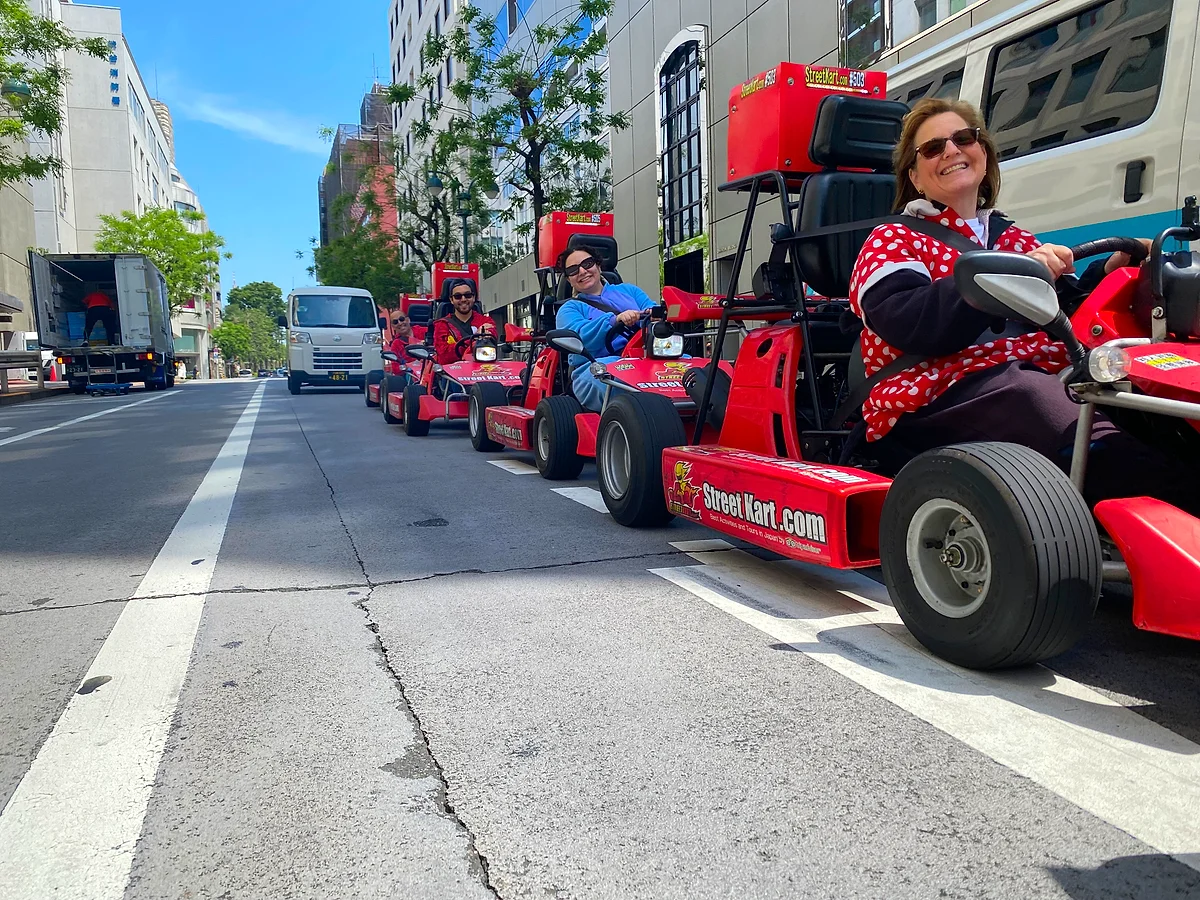
On Your Second Trip to Tokyo, Start by Changing the Station You Get Off At: Picking Trains to Street Kart and Making Smart Transfers
You get off the train at Shibuya Station. The crowd carries you through the underground passages until you finally come up to street level. On your first trip to Tokyo, even that maze counts as a travel memory.
On a second trip, though, you can explore the city a little differently.
You already know how to top up your Suica card and use a transit app. This article goes one step further: which station you get off at, and which line you take to get there. Change just those two things and the same Tokyo starts to feel like a slightly different city. Getting to a Street Kart location is a good way to practice.
Why Take the Train to Street Kart?
First, a practical point. Street Kart locations don't have parking, so you'll need to come by train, bus, or other public transportation.
That's not bad news. Tokyo's trains get more interesting on your second visit.
On a first trip, most people head for the big stations: Shibuya, Shinagawa, Akihabara. You know the names, so they feel safe, and the English signage is good. But big stations have a huge number of exits, and getting from the ticket gate up to street level can take a while. If your destination is some distance from the station, every minute you spend lost inside it makes you that much later.
On a second trip, you can pick a smaller station one stop over, or a line run by a different railway company. You get off at a station with a single platform, climb the stairs, and you're already at the edge of a residential neighborhood or a local shopping street. The air outside is nothing like what you find outside the big stations.
Below, we go through each Tokyo location and suggest a station to try on your second visit. There are seven locations in Tokyo, but Akihabara 1 and Akihabara 2 are close together, and so are Shibuya and Shibuya Annex. Each of those pairs is covered in one section, since the main question is where you're coming from.
Shibuya & Shibuya Annex: Skip Shibuya Station
Both Shibuya locations are about a 10-minute walk from Shibuya Station. From Shinsen Station on the Keio Inokashira Line, the walk is only 5 minutes.
In practice, the difference matters more than the numbers suggest.
Shibuya Station is served by JR, Tokyo Metro, Tokyu, and Keio. It's enormous. You exit the gates, push through the crowds at the Scramble Crossing, and walk up the hill. On your first trip, that was sightseeing in itself. But when you have a fixed reservation time, the same walk can take much longer than you expect.
Shinsen is a small station one stop from Shibuya on the Inokashira Line. When you leave the gates, you're in a quiet hillside neighborhood that feels nothing like central Shibuya. Instead of neon, the street is lined with houses and small shops. Go a short distance and the city changes completely. That's one of the things that makes Tokyo so interesting.
When you enter the destination in your map app, it helps to save the address as well as the store name. Both Shibuya and Shibuya Annex are in Maruyamacho, Shibuya-ku. Pull up the route once while you're still on the train, instead of opening the map after you leave Shinsen Station, and you won't have to stop and get your bearings outside the gates.
If you're transferring to the Inokashira Line at Shibuya from another line, give yourself extra time. This is the first key point about transfers. Going from JR or the subway to the Inokashira Line involves a fair amount of walking inside the station, so plan for a little more time than your app shows.
Each tour follows a set course for its location, with a guide leading the way. From the Shibuya locations, the course takes you past the zelkova-lined avenue of Omotesando and around Harajuku and Takeshita Street. If something catches your eye from the kart, you can go back and explore it on foot before or after the tour.
On the way back, consider walking to Shibuya Station. In about 10 minutes you'll come out near the Scramble Crossing and the Hachiko statue. Shibuya Sky, the observation deck at Shibuya Scramble Square, and Shibuya Hikarie are also about 10 minutes on foot from the locations. Shinsen's quiet hillside streets on the way in and Shibuya's crowds on the way out give you two sides of Tokyo in half a day.
If you have time, you could also go on to Meiji Jingu or Yoyogi Park, both about a 20-minute walk from the locations. Walk through a forest and wide lawns you'd never expect in central Tokyo, then step back into the bustle of Shibuya, and you'll be struck again by how much the city can change from one block to the next.
Shinagawa: Use the Small Keikyu Station, Not the Shinkansen Hub
The Shinagawa location is in Kita-Shinagawa. The nearest station is Kita-Shinagawa on the Keikyu Main Line, 3 minutes away on foot. Shimbamba Station, also on the Keikyu Main Line, is a 7-minute walk.
It's also about a 10-minute walk from Shinagawa Station. Since the shinkansen, JR, and Keikyu all stop there, this location is easy to fit into the day you arrive in Tokyo by shinkansen.
On a second trip, though, take one extra step at Shinagawa Station: switch to the Keikyu Line and get off at Kita-Shinagawa. That short ride can change how the whole trip feels.
The area around Shinagawa Station is a business district lined with tall office towers and hotels. By the time you reach Kita-Shinagawa, the feel of the streets has shifted toward an older Tokyo. The Kita-Shinagawa Shopping Street is full of long-established shops. After walking through Shinagawa Station's huge concourse, the contrast is a lot of fun.
Five minutes on foot from the location is Shinagawa Shrine, one of the Ten Shrines of Tokyo. A torii gate stands at the top of a stone staircase, and the grounds include a fujizuka, a small mound built to imitate Mount Fuji. You can climb it, so it's a nice way to loosen up before your tour.
If you're up for a longer walk, Honsenji Temple is about 10 minutes from the location. The temple is more than 1,200 years old and is home to one of the Six Jizo of Edo, along with a large temple bell designated a Tangible Cultural Property of Tokyo. Stand in front of that bell after seeing the towers around Shinagawa Station and you'll get a sense of how much history the name "Shinagawa" carries.
Highlights of the Shinagawa course include the Rainbow Bridge, Tokyo Tower in the distance, and the waterfront scenery of Shibaura and Tamachi.
For a walk after your tour, Tennozu Isle is about 20 minutes away on foot, a canal-side area with art galleries and cafés. Another option, also about 20 minutes away, is Sengakuji Temple, where the Ako Roshi, known in English as the "47 Ronin," are buried. The story of the 47 retainers who avenged their lord is known in Japan as Chushingura. If you saw the big landmarks on your first trip, small places with deep stories like these tend to stay with you.
Akihabara 1 & Akihabara 2: Keep Three Stations in Mind
Akihabara is served by a lot of lines. You have Akihabara Station (JR, Tokyo Metro Hibiya Line, Tsukuba Express), Suehirocho Station (Tokyo Metro Ginza Line), and Iwamotocho Station (Toei Shinjuku Line). All of them are within walking distance of the locations.
One thing to watch: since Akihabara has two locations, where you're headed depends on which one you booked. Check your reservation before you set out.
The listed distances from the nearest stations also differ slightly between the two. Akihabara 1 is a 3-minute walk from Suehirocho Station on the Ginza Line and 5 minutes from JR Akihabara Station. Akihabara 2 is a 7-minute walk from JR Akihabara Station. Once you know which location you booked, put its address into your map app and check ahead of time which station gives you the shortest walk. It makes the day much easier.
On your second visit to Akihabara, try Suehirocho Station on the Ginza Line. The Electric Town exit of Akihabara Station is always packed with people and signs, and on a first trip, all that dazzle can be the whole point. Walk in from Suehirocho, though, and you enter Akihabara gradually from the edge of Electric Town. The volume of the neighborhood rises bit by bit as you head toward the signs on the main street. The more of Akihabara you've already seen, the more you'll enjoy approaching it this way.
Another tip: work backward from the line your hotel is on. If you're staying near the Toei Shinjuku Line, use Iwamotocho. If you're on the Hibiya Line, use Akihabara Station. With this many lines, it's worth looking for the combination that cuts down on transfers.
Highlights of the Akihabara course include the red-brick Marunouchi Building of Tokyo Station and the Wako clock tower at the Ginza 4-chome intersection. The station building opened in 1914 and finished its restoration in 2012. No matter how many times you see it, it's still impressive.
For a side trip before or after your tour, Kanda Myojin is about 10 minutes on foot from the locations. It has a 1,300-year history as the guardian shrine of old Edo. Walk just 10 minutes from the buzz of Electric Town and everything goes quiet. Ueno Park is about 5 minutes away by train, so you could also add a museum or gallery visit.
Tokyo Bay (Shin-Kiba): Choose Which of the Three Lines to Take First
The nearest station to the Tokyo Bay location is Shin-Kiba, an 8-minute walk away. It's served by three lines: the JR Keiyo Line, the Tokyo Metro Yurakucho Line, and the Rinkai Line.
Here, the line you choose effectively shapes your whole day.
Whether you arrive on the JR Keiyo Line or the Yurakucho Line, the walk from Shin-Kiba Station to the location is about 8 minutes, and the route from the station is the same. So the real question is which line to take to Shin-Kiba. Once you've decided that, there's almost nothing left to get lost on.
For example, if you come by the Yurakucho Line, Toyosu Station is on the same line. Toyosu Market is busiest from early morning through late morning, so it's easy to have a seafood breakfast first and then head on to Shin-Kiba. If you're staying near a different line, the simplest option is to pick one that gets you to Shin-Kiba without transferring.
The area around Shin-Kiba Station is a bayside mix of sea, warehouses, and newer buildings. When you step out of the station, a breeze with a hint of salt drifts in. It feels far more open than the office districts downtown.
Highlights of the Tokyo Bay course include the Rainbow Bridge and Tokyo Tower: the 798-meter Rainbow Bridge and the 333-meter Tokyo Tower. Many people saw them from an observation deck or a boat on their first trip. This time, you look up at them from a kart. The same view looks completely different from a different height. At night, the Rainbow Bridge is lit up in seven colors, and on evening tours you can enjoy the night view too.
If you want to stop somewhere before or after your tour, Odaiba, Tokyo Big Sight, and Kasai Rinkai Park are all good options. All of them, however, are a drive away from the location. If you're getting around by train, look up the nearest station to where you want to go and plan your transfers from Shin-Kiba in advance, and you won't get lost.
Transfer Tips for Every Location
The following advice applies no matter which location you're heading to.
First, leave with plenty of time to spare. Tokyo's trains run on time, but the trains are what's punctual, not your transfers. At large stations, getting from one platform to another can take more walking than you'd expect. A "3-minute transfer" in an app may be timed for someone who knows the station inside out. At an unfamiliar station, catching one train earlier is about right.
Next, check the exit number. Transit apps and Google Maps will often tell you exactly which numbered exit to use. Subway stations have lots of exits, and if you come out on the wrong side, you can lose several minutes on the street. Check the exit number before you get off. That alone makes arriving a lot calmer.
If you still get lost, the quickest fix is to ask station staff. "Where is ___ Station?" is "___ eki wa doko desu ka?" in Japanese. Asking in English is fine, but adding the name of the station you want in Japanese tends to get you an answer faster.
Think about your luggage when you choose your trains, too. The locations have lockers for small items, but they're not suited to large luggage such as suitcases. If you plan to come on your check-out day, decide ahead of time what you'll do with your big bags. If you're not sure how to handle them, check the official website before you go. Traveling light also makes the stairs at transfers much easier.
Wear closed-toe shoes such as sneakers. Sandals, heels, skirts, and dresses aren't suitable for the karts. Since you may also be walking up Shinsen's hills or through Kita-Shinagawa's shopping street on the way, comfortable clothes you can move in are your best bet.
Book early. Weekends tend to fill up, so if you want to ride on a Saturday or Sunday, lock in your booking as soon as your travel dates are set. Reservations are accepted via Facebook, LINE, and email, and you can find the contact details on the official website. Note that tours are generally guided in English on the day. Guidance in Japanese or other languages depends on the staff on duty, so it can't be guaranteed.
Don't forget to sort out your driver's license, either. You need a driving license to ride with Street Kart. Even if you've ridden before, check before you leave that your license is still valid and that you have all the required documents for this trip. For full details on requirements, see the official website (kart.st).
One last tip: finish checking your route by the time you leave the station. Once you're in the kart, follow your guide and focus on the view in front of you. That way you can enjoy the experience fully.
Your Next Tokyo Trip Starts Before You Board the Train
Your first trip to Tokyo was about seeing the famous places with your own eyes. Your second can be about enjoying how you get between them.
Will you climb the hills of Shinsen? Walk through the Kita-Shinagawa shopping street? Approach Electric Town from Suehirocho? Or choose one of the three lines to Shin-Kiba? Whichever you choose, a different Tokyo from last time has already begun before you even take the wheel.
Weekends tend to fill up, so once you've decided on a location and a date, book early. Details for each location and reservation contacts are all on the Street Kart official website.
So, which station will you get off at this time?
This article was originally written in Japanese and translated using AI. Some expressions may read unnaturally, and we appreciate your understanding. For the most accurate and up-to-date information, please refer to the official site at kart.st.
Street Kart is not affiliated with Nintendo or the Mario Kart series in any way. We do not provide costumes of Nintendo characters, and such costumes may not be worn during tours even if brought by participants.