
Street Karting in Tokyo with a Group That Includes Strangers: 6 Common Pitfalls and How to Avoid Them
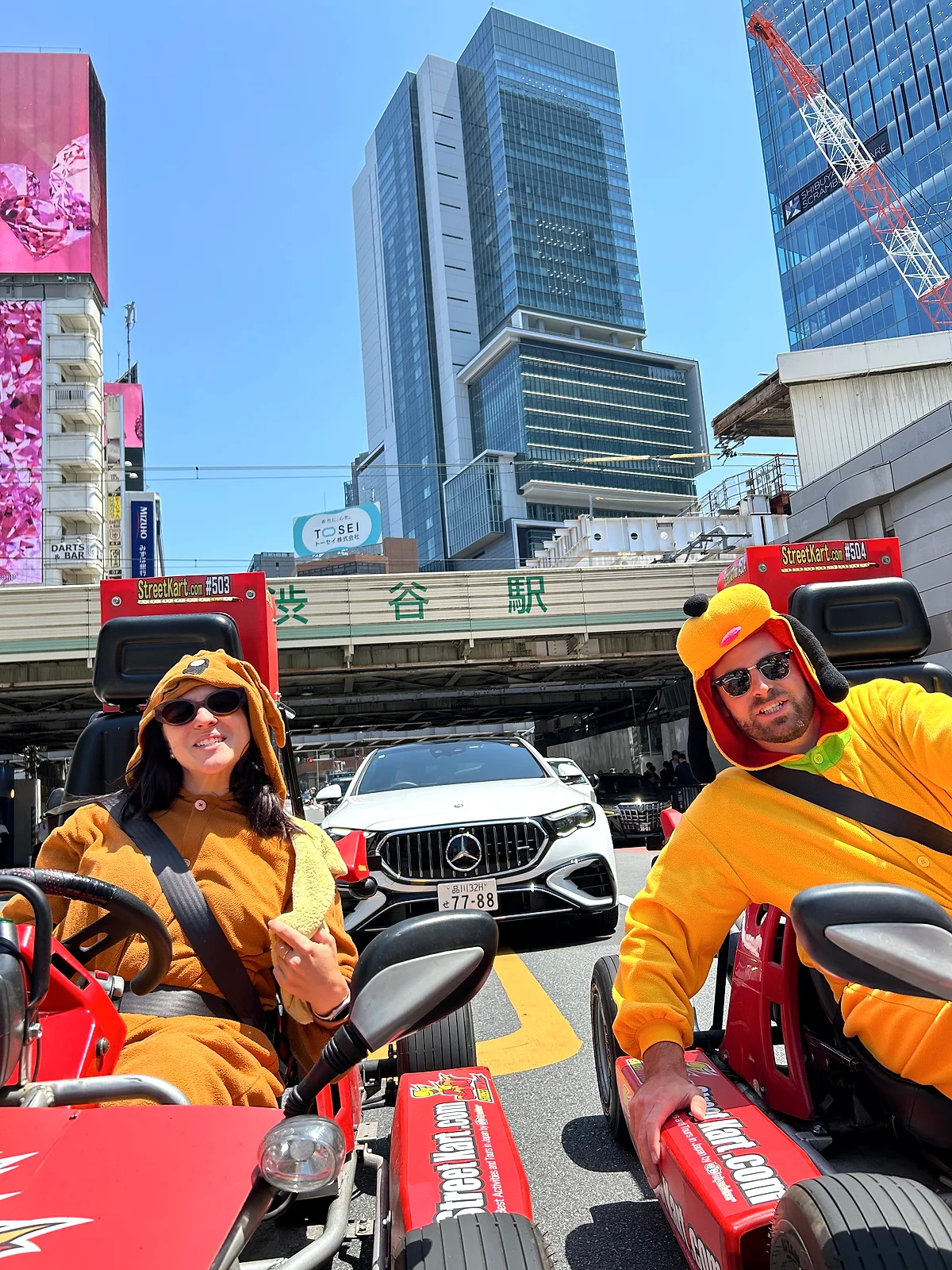
Street Karting in Tokyo with a Group That Includes Strangers: 6 Common Pitfalls and How to Avoid Them
At the meeting spot you find your friend's coworker and that coworker's roommate. There are also two people you met on social media during your trip.
Before you've learned everyone's names, you'll all be behind the wheel together.
Last time in Tokyo, you may have gone around with close friends. This time is different. When strangers are in the mix, things go wrong that never would in a group of friends.
This article covers the situations where groups with first-time acquaintances tend to stumble when going street karting in Tokyo, and how to avoid them. We'll go in order: before booking, on the day, and after the ride.
Why do groups with strangers stumble before they even set off?
Once you're on the road, things are pretty calm. Each location has a set route, and a guide at the front leads the convoy. Nobody argues about which way to go.
The trouble comes before that.
With close friends, two quick questions cover it: "You've got your license, right?" "Saturday okay?" With people you've just met, you hold back. It feels awkward to ask, so you don't. Everyone assumes someone else checked, and in the end nobody did. Then on the morning of the tour, someone says, "Actually..."
With people you met while traveling, it's easy to put off the details with an "it'll work out." Nobody means any harm, but that's how it tends to go.
The fix is simple: ask the awkward questions to everyone, in the same way. Don't aim a question at one person. Make it a check for the whole group. That way it never feels like you're suspicious of anyone.
Let's go through the six situations one at a time.
3 pitfalls before booking: licenses, scheduling, and language
Pitfall 1: Leaving the license check up to each person
This is the one you most want to avoid.
In street karting, everyone drives their own kart. "I won't drive, I'll just ride along" isn't an option. Anyone without a valid license won't be able to ride on the day.
Which licenses are accepted depends on each person's situation. Just because you could ride last time doesn't mean your new companions can.
We recommend posting the official driver's license information page in the group chat with a note like this:
"Please check this yourselves, and just react to this message once you're sure you're good."
Having everyone read the same page and decide for themselves is far less awkward than asking someone you just met, "Is your license okay?" For full details, including what to bring on the day, check the official website. For anyone who doesn't reply, a gentle second nudge after a little while is enough.
Pitfall 2: Scheduling drags on and you miss the weekend slots
When strangers are in the group, the replies about dates are slow to come in. Everyone politely says, "Either works for me," so nothing gets decided. Meanwhile the weekend slots fill up.
Weekends book up quickly, so if you want to go on a weekend, book early.
There are three tricks: pick one person to organize, narrow it down to two candidate dates at most, and set a deadline for replies.
"Which one works for you, these two days? Let me know by Friday" gets more replies than "Which day is good?"
Bookings are accepted via Facebook, LINE, email, and other channels. Check the official website for contact details. If the organizer handles everything through one channel, things stay tidy. Before booking, check the official website for the rules on changing group size and cancellations. If you also tell the group when participation will be finalized, you'll avoid "nobody told me" later.
Pitfall 3: Overlooking members who aren't comfortable with English
This one is easy to miss.
Guidance on the day of the tour is basically in English. Whether you get guidance in Japanese or other languages depends on the staff that day and isn't guaranteed. If someone isn't confident in English, they may set off without really taking in the pre-departure briefing.
The official website is available in 22 languages. Before booking, have everyone read through the site in whatever language is easiest for them. If anyone has concerns about language, contact the company through the official website in advance.
If someone in the group is good at English, they can give a quick summary of the key points while you wait before departure. But only up until you set off. While you're driving, everyone should focus on the road ahead and the guide's signals.
3 pitfalls on the day: meeting up, getting there, and mismatched expectations
Pitfall 4: Mixing up location names and heading to the wrong one
There are seven locations in Tokyo. Some of them have very similar names.
Akihabara 1st and Akihabara 2nd. Shibuya and Shibuya Annex. In each pair, the two are almost in the same spot.
If you just say "the Shibuya one," members can end up at different entrances.
To avoid this, paste the location name exactly as it appears in your booking confirmation into the group chat, without shortening it. When searching on Google Maps, have everyone search by the official location name, not the neighborhood.
One more thing: in Shibuya, avoid "meet at Hachiko." It's far too crowded, and you'll almost never find someone whose face you barely know.
The Shibuya location is a 5-minute walk from Shinsen Station and a 10-minute walk from Shibuya Station. It's safer to gather once just outside the station's ticket gate and walk over together once everyone has arrived.
Pitfall 5: Driving there and arriving late
"Wouldn't it be easier to carpool in someone's car?"
We get it. But the locations have no parking. If you drive, you'll start by hunting for a place to park, and you could miss the meeting time. Plan on using public transportation.
In a group of close friends, "Sorry, running late!" gets a laugh. With strangers in the mix, it doesn't. Everyone else stands silently in front of the shop waiting for one person. That atmosphere is pretty rough.
Set the meeting point at the station nearest the location, and leave some time to spare. If anyone isn't used to transferring between trains, share a screenshot of the route the day before. That alone cuts down a lot of last-minute chaos.
Pitfall 6: Someone thinks you can stop wherever you like
A first-timer pipes up: "Let's stop at that crepe shop on Takeshita Street along the way."
The tour follows a set route for each location, led by a guide. Don't count on being able to stop wherever you want along the way. If there's somewhere you want to visit, plan to walk there before or after the tour.
Also, check the official website to see who else might be riding in your tour. If someone is imagining "a private tour with just our group," checking ahead of time prevents disappointment on the day.
If anyone is nervous, don't tease them about their pace or driving. Take photos and videos before and after the ride, and keep phones put away while driving. If everyone agrees on these rules at the start, nobody ends up feeling awkward.
Why Street Kart works especially well for people who've just met
So far it's all been about what can go wrong. But I actually think street karting is a great match for groups that include strangers. Here are a few reasons.
First, a guide leads the way. When you go sightseeing with people you've just met, whoever knows the area naturally ends up as the tour leader, and they're the only one who doesn't get to enjoy it, right? While you're driving, everyone, organizer included, gets to just be a participant.
Second, everyone starts from the same line. Before setting off, you get a safety briefing. Repeat visitors who've been to Tokyo many times and people you met just today are all equal participants here. To warm up to someone you've just met, a situation where "everyone is a little out of their element" is just right.
Third, conversation topics appear on their own. The Shibuya route includes the Scramble Crossing and the zelkova-lined avenue of Omotesando. The Akihabara routes take in the red-brick Marunouchi building of Tokyo Station and the streets of Ginza. From the Tokyo Bay and Shinagawa locations, the highlights are the Rainbow Bridge and the 333m Tokyo Tower. Even places you've walked past before look different from a kart. After the ride, you can ask each other "Did you see that part by the bridge?" so conversations keep going even with people you have no shared memories with.
Fourth, there's the feeling of being in the kart. Once you start moving, the wind, the sound bouncing off the buildings, and the engine of the bus in the next lane all hit you at once. At a red light, the person in the kart ahead turns around and smiles at you. Just that is enough to close a bit of the distance that felt so awkward a little while ago.
Fifth, you don't have to force conversation. I think the most exhausting part of any gathering with strangers is working hard to fill the silences. While in the karts, everyone is naturally looking ahead and driving. Not talking isn't awkward. For shy members, this makes a big difference.
Sixth, the track record. As of November 2023, there have been more than 150,000 tours in total, more than 1.34 million customers, and an average rating of 4.9 out of 5.0. When a first-timer asks, "What's it like?", having numbers makes it easier to explain.
Finally, every location has places nearby worth stopping by. I'll cover that in the next section.
The real fun starts after the ride: planning an "after-party" near the location
If you want to keep hanging out after the tour, decide on the next destination in advance. Otherwise, everyone's excited, but because nothing's been decided, nobody wants to be the one to suggest it.
So decide where to go after the tour before the tour. The places listed here aren't on the tour routes. They're options near each location that you can walk to before or after your experience.
For Shibuya or Shibuya Annex, Shibuya Niku Yokocho, about a 10-minute walk away, is a good option. When you're hungry after the ride, you can head straight there.
For the Akihabara locations, it's fun to stop by Kanda Myojin shrine, about a 10-minute walk away, before the tour. It's said to bring luck in relationships, so jokingly offering a prayer "for today's new connections" lightens the mood before setting off. Afterward, you could settle in for a chat at Kanda Yabu Soba, a long-established soba restaurant about a 15-minute walk away.
For Shinagawa, there's Shinagawa Shrine about 5 minutes away on foot, or Tennozu Isle about 20 minutes away. Tennozu Isle has cafés and galleries along the canal, and as you stroll and chat, a circle forms naturally. For the Tokyo Bay location, you can unwind after the ride at CASICA, a café and restaurant at Shin-Kiba Station.
Once you're in the restaurant, try making your first toast in Japanese:
"Otsukaresama deshita" (お疲れさまでした)
It means something like "You did great today, thanks," and works fine even among people who've just met. For a greeting before setting off, try "Yoroshiku onegaishimasu" (よろしくお願いします). With these two phrases, you can pretty much set the tone for the beginning and the end.
Next time in Tokyo, drive side by side with someone new
In a group that includes strangers, check the awkward things in advance.
Share the license information page with everyone and have each person check for themselves. Set a deadline and decide on dates early so you don't miss the popular weekends. Let everyone know ahead of time that guidance is basically in English. Share location names in full. Travel by train. And mention up front that the route is fixed.
All of this takes nothing more than a quick message in the group chat a few days before.
If you're the organizer, why not start by opening the Street Kart official website and having everyone read it in their own language? Booking contacts are listed on the official website too.
Faces that were almost strangers at the start are, by the time of the toast, asking "Which location should we try next?" When that happens, you'll have a Tokyo memory a little different from last time.
This article was originally written in Japanese and translated using AI. Some expressions may read unnaturally, and we appreciate your understanding. For the most accurate and up-to-date information, please refer to the official site at kart.st.
Street Kart is not affiliated with Nintendo or the Mario Kart series in any way. We do not provide costumes of Nintendo characters, and such costumes may not be worn during tours even if brought by participants.