
Walk Shinjuku's Skyscrapers Step by Step, Then Look Up from a Kart Seat in Shibuya and Shinagawa: Rereading the City on Your Second Trip to Tokyo
Walk Shinjuku's Skyscrapers Step by Step, Then Look Up from a Kart Seat in Shibuya and Shinagawa: Rereading the City on Your Second Trip to Tokyo
Leave Shinjuku Station and head west.
After just a few minutes on foot, the sky shrinks. The open sky that was over your head a moment ago gets squeezed into thin strips between the buildings. That alone makes it feel like you've arrived in a different city.
On their first trip, a lot of people probably treated Shinjuku as just a place to change trains. You get lost in the huge station, hunt for an exit, and before you know it you're on a train to your next stop. That's it for Shinjuku. Honestly, that's what happened to most of my friends from overseas.
A second trip to Tokyo is a different story. I'd love for you to walk around the base of those towers one step at a time, at your own pace. You won't find this spot on most sightseeing lists. But if you pay attention to the order in which you look at things, you start to feel how Tokyo was built up, layer by layer, before you can even put it into words.
This article walks you through how to take in Shinjuku's skyscraper district: first the ground at your feet, then the wind, then the glass. At the end, I'll connect it to a different experience: getting that same looking-up feeling from the seat of a kart somewhere else in Tokyo.
First, let me be completely clear.
Street Kart has no location in Shinjuku. And the Shinjuku skyscraper district is not on any of the tour routes.
So the first half of this article is entirely about walking. I really don't want you to read on thinking you can drive a kart through Shinjuku and end up disappointed.
Street Kart tours follow a set route for each location, with a guide leading the way. You can't just drive anywhere you like.
You explore the Shinjuku towers on foot, and you ride a kart at a different location in Tokyo. I actually think that's a great combination for a second trip. Once you've walked under those towers and looked up at them, seeing buildings in another part of the city from a kart feels completely different.
Step 1: Getting to the West Side of the Station Is the First Hurdle
For first-timers, Shinjuku Station is basically a dungeon. I've lived in Japan for five years, and I still pick the wrong exit sometimes.
There's only one trick: follow the signs for the "West Exit" (Nishiguchi) and nothing else.
Most signs are in both Japanese and English, so forget everything else for now and just keep your eyes out for the word "West." Think of it as a treasure hunt.
If you're using Google Maps, don't set the station itself as your destination. Pick a major street or intersection on the west side of the station instead, and you'll be much less likely to get lost. GPS tends to be unreliable inside the station, so don't panic if the blue dot on your map jumps all over the place.
Here's one Japanese phrase for when you get lost: "Nishiguchi, dotchi desu ka?" (Which way is the West Exit?). Station staff and passersby will usually just point you in the right direction. Asking "West Exit?" in English often works too.
The moment you get through the crowds, the sound changes. The hum of voices layered over train announcements slowly gives way to the sound of traffic and footsteps.
This is where the skyscraper district begins.
Step 2: Before You Look Up, Look Down
When people step into the skyscraper district, almost everyone looks straight up and pulls out their phone.
It's a classic tourist move. Then their neck starts to hurt and they're bored within five minutes.
So why not flip the order? Look at the ground first.
At the base of most skyscrapers you'll find plazas, planters, and open areas built on different levels. Office workers eating lunch on benches. People pushing strollers, sticking to the shade. Pedestrian bridges and raised decks connecting one building to the next.
What looks like a single line from above turns out to be split into several levels down at your feet.
In American cities, the area around the base of a skyscraper tends to be pretty plain. Usually it's just sidewalk next to road. In Tokyo's office districts, you keep noticing all the ways they've tried to separate the level where people walk from the level where cars drive. You climb a set of stairs and suddenly you're at the entrance of a completely different building. That happens a lot.
It's confusing at first. Once you get used to it, though, it's fun, like a three-dimensional maze.
Only after you've had a good look around at ground level should you look up. Do it in this order and a building's height stops being a number in meters. It becomes a distance: from right here where I'm standing, all the way up to there.
Step 3: The Wind Changes Direction Between the Buildings
As you walk between the towers, you may turn a corner and get hit head-on by a sudden gust.
In Japanese, this is called biru-kaze, or "building wind."
It was calm a second ago, and now your hair is blowing sideways and the hem of your jacket is flapping wildly. It happens when air rushes through the gaps between tall buildings, so you can run into it anywhere skyscrapers are clustered together.
What I find interesting is that the wind shows you the shape of the city. Where the buildings open up, and where the air gets squeezed. You can feel the city's hidden framework on your skin, even though you can't really see it.
By the way, how strong the wind gets varies a lot with the season and the weather. Some days it's just a breeze. Other days an umbrella is completely useless. If rain is in the forecast, I think a light rain jacket is easier to deal with than a folding umbrella.
Step 4: Look for the Sky Reflected in the Glass
You've looked at the ground. You've felt the wind. Then you looked up.
Now take a look at the buildings' surfaces.
Many skyscrapers are covered in glass or metal panels. The building across the street shows up in the glass of the one in front of you, and beyond that you can see the sky. The city appears two or three times over within a single wall.
If you're taking photos, I personally prefer shooting the glass walls at an angle instead of pointing straight up. When clouds are moving, the reflected sky drifts slowly across the glass, and the building almost seems to be breathing.
Video is fun too. Slowly pan left and right across the narrow strip of sky framed by the building walls. It captures what it feels like to stand at the bottom of a canyon.
The light changes a lot depending on the season and the weather, so I won't tell you there's one "best time." On cloudy days the glass evenly reflects the gray of the sky, and a whole building can look like a single sculpture. It's a completely different look from a sunny day.
Neither one is the right answer. Whatever the sky is doing that day is the answer.
Step 5: The Same Street Becomes a Different City on Weekdays and Weekends
The skyscraper district on the west side of Shinjuku is mainly an office area, so the mood changes quite a bit depending on what day you go.
On weekdays, people with ID badges around their necks walk briskly past each other. There are short lines in front of convenience stores and cafés. Getting to see up close how fast Japanese office workers move is a rare chance, in a way. In the US, I feel like more people walk at a slightly more relaxed pace, but in Japan, walking speed itself seems to set the rhythm of the city.
On weekends, the same streets can get surprisingly quiet. Just a few people sitting here and there on the plaza benches. Your footsteps bounce off the buildings and sound a little louder than usual.
An empty office district has a completely different vibe from a weekday, a bit like a scene from a sci-fi movie.
If you have the time, try comparing the two. Just by walking the same street twice, you get to see Tokyo's "working face" and its "resting face."
Step 6: Feel Where the City Changes on Your Way Back to the Station
Once you've walked around the skyscrapers, head back toward the station. You can take the same route you came in on.
On the way back, the buildings gradually get lower. They get packed more tightly together, and more and more signs appear. You move from a world of glass and metal into a world of lettering and color. Over a few hundred meters, the character of the city slowly shifts.
Being able to walk while paying attention to these boundaries is, I think, the biggest reward for exploring in this order.
On your first trip, Shinjuku probably looked like one big blob. The second time, you can see that it's made up of many layers and blocks. That alone changes how you read a map of Tokyo, just a little.
Now Get That Looking-Up Feeling from a Kart Seat
Okay, now let's talk about karts.
I'll say it one more time: the Shinjuku skyscraper district is not on any Street Kart tour route. That said, if you want to experience that feeling of passing through canyons of tall buildings somewhere else in Tokyo, some locations list areas lined with tall buildings in their route information.
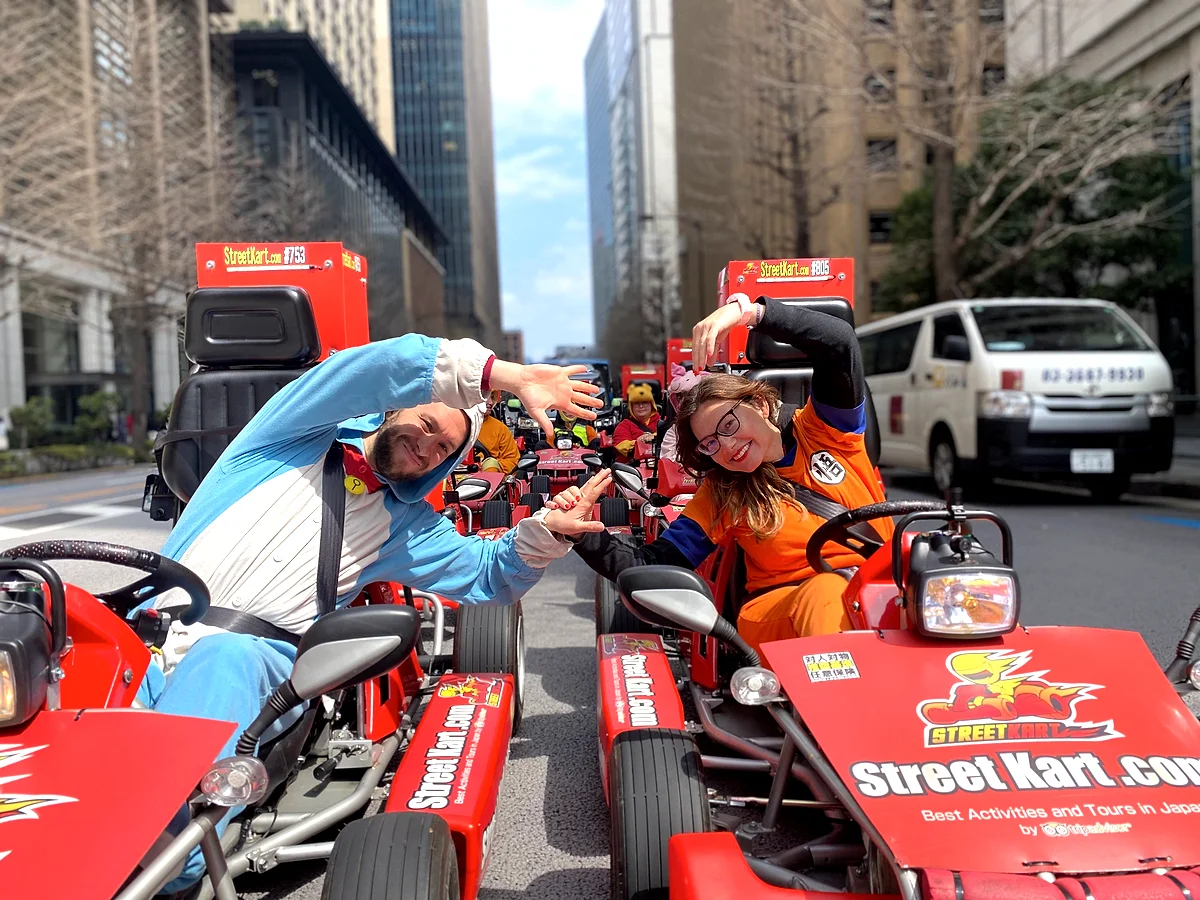
When you sit in a kart, your eye level drops a lot. When you're walking, the base of a building sits a little above your eye line. From a kart, it looks like it's looming right over your head. The engine's vibration travels through the steering wheel to your fingertips, and the sound of driving bounces off the building walls and comes back to your ears.
You'll also take the building wind from Step 3 with your whole body when you're in a kart.
If you've already walked around Shinjuku and looked up at the towers, you should notice this difference clearly.
The Shibuya location and Shibuya Annex are two locations in almost the same spot.
Their route information lists buildings created by the redevelopment around Shibuya Station, such as Shibuya Hikarie, Shibuya Scramble Square, and Shibuya Stream. The same information also includes the Shibuya Scramble Crossing and Omotesando, with its zelkova-lined avenue and distinctive buildings by well-known architects.
If Shinjuku is "a cluster of office towers," Shibuya's new buildings are a neighborhood that grew up together with the station and its shops. Shinjuku, which you looked up at on foot, and Shibuya, which you gaze up at from a kart seat. Both are Tokyo's tall buildings, but I think you'll find the distance between the buildings and the people feels very different.
The location is about a 5-minute walk from Shinsen Station on the Keio Inokashira Line, or about a 10-minute walk from Shibuya Station.
If you want to walk around before or after your tour, it's fun to look down over the city from Shibuya Sky, the observation deck at Shibuya Scramble Square. Later, you'll see the same streets you looked down on from just above the ground.
The Shinagawa location's route information lists the high-rises around Shinagawa Station, Shinagawa Intercity, the Shinagawa Prince Hotel, and Takanawa Gateway Station. The same information also mentions office buildings in the Shibaura and Tamachi area, the Rainbow Bridge as seen from the Shinagawa side, and Tokyo Tower in the distance.
If you want to feel the atmosphere of a working district's high-rises, similar to west Shinjuku, from a kart, the Shinagawa location may be closest to what you have in mind.
The location is about a 3-minute walk from Kita-Shinagawa Station on the Keikyu Main Line, or about a 10-minute walk from Shinagawa Station. Before your tour, I'd also recommend stopping by Shinagawa Shrine, about a 5-minute walk away, and climbing its stone steps. A completely different side of Tokyo sits right next to the office towers.
None of the locations have parking. Please get there by train or other public transportation.
You can take the train from Shinjuku to Shibuya or Shinagawa, so it's easy to plan a day where you walk the skyscraper district and then head straight to a location by train.
Now, here's a summary of what the available information confirms about Street Kart itself.
First, every tour is led by a trained guide. Each location has its own set route, and you drive behind the guide.
Second, tours are generally guided in English on the day. Guidance in Japanese or other languages depends on the staff working that day, so it can't be guaranteed. If this matters to you, please check the official website for details.
Third, the website is available in 22 languages. But that's the website. It's separate from the language used on the tour itself, so please don't mix the two up.
Fourth, there are 9 locations across Japan: 7 in Tokyo, plus 1 each in Osaka and Okinawa. Of the 7 Tokyo locations, though, Akihabara Locations 1 and 2 are in almost the same spot, and so are the Shibuya location and Shibuya Annex. Route information for the Tokyo Bay location (Shinkiba) lists the Rainbow Bridge and Odaiba, while the Akihabara locations list Tokyo Station's red-brick station building and Ginza. Each location shows you a completely different side of Tokyo. On a second trip, it could be fun to choose a location in a different area from last time.
Fifth, past records. As of November 2023, across all locations combined, there had been more than 150,000 tours, more than 1.34 million customers, more than 20,000 reviews, and an average rating of 4.9 out of 5. These aren't current figures, just the record as of that point.
Sixth, the city is right there. Not on the other side of a window: the buildings, the traffic lights, and the people walking along the sidewalk feel close enough to touch. You get to revisit the "city you look up at" that you experienced on foot in Shinjuku, but in a different part of Tokyo, from a different height. That's how I see it.
What to Check Before You Book
First, your driver's license. There are requirements for taking part, and what you need depends on your country and the type of license you have. If you rely on your own assumptions here, you might not be able to drive on the day. Please check the official page about driver's licenses in advance to see whether your license qualifies.
Prices vary by season and time of day, so they aren't included in this article. Please check the official website (kart.st) for the latest prices. Tour length and departure times also vary by location and plan.
Bookings are accepted through Facebook, LINE, and email, and the contact details are listed on the official website. Please check the official website for the full booking steps as well.
Weekends tend to fill up fast, so if you want to ride on a weekend, I recommend booking early. If you're planning to walk the Shinjuku skyscrapers on both a weekday and a weekend, one option is to do the kart tour on a weekday and save the weekend for walking the quiet office district.
Read Your Second Tokyo by Height
On your first trip to Tokyo, just getting around the famous sights one by one was probably all you could manage.
This time, try looking at the streets between those points.
Get out to the west side of the station. Look at the ground. Feel the wind. Look for the sky reflected in the glass. Compare weekdays and weekends. Notice where the city changes as you head back to the station.
Walk in that order, and Shinjuku stops being just "a place with lots of buildings." You start to see it as a city made of many overlapping layers.
Keep that feeling in your pocket, then look up at the buildings again in Shibuya or Shinagawa, this time from a seat just above the ground. The same tall buildings of Tokyo should look like a completely different city.
Which location will you pick, and which side of Tokyo will you see? Start by comparing each location on the Street Kart official website.
There'll be plenty of time to hurt your neck after that.
This article was originally written in Japanese and translated using AI. Some expressions may read unnaturally, and we appreciate your understanding. For the most accurate and up-to-date information, please refer to the official site at kart.st.
Street Kart is not affiliated with Nintendo or the Mario Kart series in any way. We do not provide costumes of Nintendo characters, and such costumes may not be worn during tours even if brought by participants.